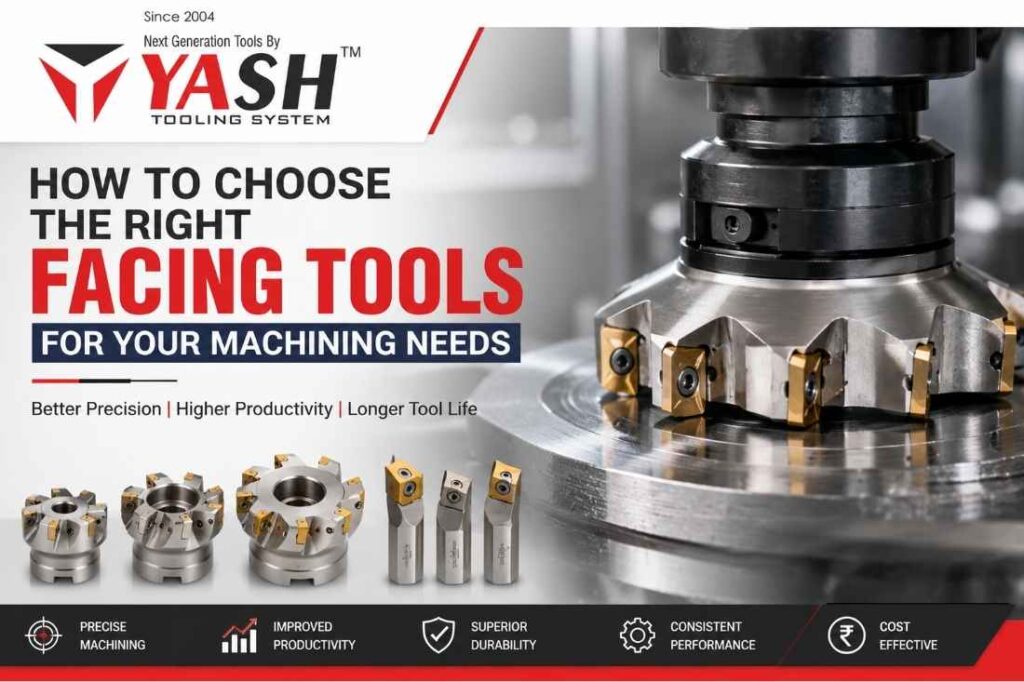
In modern manufacturing, precision, productivity, and surface quality directly influence the success of a machining operation. Among the many cutting solutions used in workshops and production facilities, Facing Tools play an important role in preparing a workpiece for accurate and efficient machining. The right tool can create a smooth surface, maintain dimensional accuracy, reduce machining time, and improve the overall performance of a CNC machining process.
However, choosing the correct tool is not simply a matter of selecting a cutter that fits the machine. Workpiece material, machining operation, tool geometry, cutting conditions, surface-finish requirements, machine capability, and production volume all affect the final decision.
For that reason, manufacturers should evaluate their complete machining requirements before investing in a cutting solution. A well-selected tool can deliver consistent results while also reducing tool wear, production interruptions, and unnecessary operating costs.
This guide explains how to select the right solution for different machining requirements. It also covers important tool characteristics, material compatibility, cutting parameters, common mistakes, maintenance practices, and practical selection tips.
What Are Facing Tools?
Facing is a machining operation that removes material from the surface of a workpiece to create a flat, smooth, and accurately positioned face. The operation commonly takes place on CNC lathes, machining centers, and other machine tools.
A suitable cutting tool moves across the workpiece surface while removing a controlled amount of material. As a result, the process can establish a reference surface for subsequent operations.
Facing applications appear across several industries, including:
- Automotive component manufacturing
- Aerospace machining
- General engineering
- Tool and die manufacturing
- Industrial equipment production
- Hydraulic and pneumatic component manufacturing
- Heavy engineering
- Medical component production
- Precision component manufacturing
The cutting solution must match both the machine and the workpiece. Therefore, understanding the application should always come before choosing the tool.
Why the Facing Operation Matters
A properly executed facing operation provides more than a visually smooth surface. It can establish the dimensional reference required for drilling, turning, milling, threading, assembly, and inspection.
Furthermore, a consistent face can help improve component alignment. In high-precision manufacturing, even a small variation in flatness or surface finish can affect the performance of the finished component.
For that reason, manufacturers should treat tool selection as an important part of the overall machining strategy.
Key Factors to Consider When Choosing Facing Tools
There is no single cutting solution that works perfectly for every application. Instead, manufacturers should evaluate several technical factors before making a selection.
1. Workpiece Material
The first consideration should be the material being machined.
Different materials respond differently to cutting forces, heat, and tool geometry. For example, aluminum generally allows higher cutting speeds than many hardened steels. Stainless steel, on the other hand, can generate significant heat and work hardening during machining.
Common workpiece materials include:
- Mild steel
- Carbon steel
- Stainless steel
- Alloy steel
- Cast iron
- Aluminum
- Brass
- Copper
- Titanium
- Hardened materials
- Engineering plastics
Each material may require a different insert grade, cutting edge, coating, or geometry.
2. Cutting Material Selection
Tool material plays a major role in machining performance. Carbide remains a popular choice because it offers a strong combination of hardness, wear resistance, and cutting performance.
For demanding applications, manufacturers may consider coated carbide or specialized grades designed for specific material groups.
3. Why Tool Material Matters
The cutting edge experiences friction, heat, impact, and mechanical stress during machining. A suitable material helps the edge maintain its performance for longer.
Therefore, choosing the correct tool material can improve:
- Tool life
- Cutting stability
- Surface finish
- Production consistency
- Machining efficiency
4. Machine Type and Spindle Capability
Before selecting a cutting solution, check the machine’s specifications.
Important machine parameters include:
- Spindle speed range
- Maximum spindle power
- Machine rigidity
- Feed capability
- Tool holder compatibility
- Coolant system
- Maximum workpiece dimensions
- CNC control capabilities
A tool designed for high-speed machining may not perform efficiently on a machine with limited spindle speed or power.
Similarly, a large cutter may place excessive load on a smaller machine. Consequently, tool dimensions should always match the machine’s available capacity.
5. Required Surface Finish
Surface finish requirements also influence tool selection.
If the application requires a fine finish, the cutting geometry, insert nose radius, feed rate, cutting speed, and machine stability become especially important.
For roughing operations, manufacturers usually prioritize material removal and productivity. For finishing operations, however, dimensional accuracy and surface quality often receive greater attention.
A practical approach is to select the tool according to the specific stage of machining rather than expecting one configuration to handle every operation.
6. Material Removal Requirement
Consider how much material needs to be removed from the workpiece.
A roughing operation may require a robust cutting edge capable of handling higher cutting loads. In contrast, a finishing operation generally requires controlled cutting action and predictable surface quality.
When substantial material removal is necessary, a strong tool geometry can help maintain stability. Meanwhile, lighter finishing cuts may benefit from sharper geometry.
7. Tool Diameter and Cutting Coverage
Tool diameter determines how much of the workpiece surface the cutter can cover during each pass.
A larger diameter can provide broader coverage and potentially reduce the number of passes. However, larger tools can also require more spindle power.
Therefore, the ideal diameter depends on the workpiece size, machine capability, cutting depth, and required production rate.
Types of Facing Tools for Different Applications
Manufacturers can select from different tool configurations depending on the machining process and desired result.
1. Indexable Facing Cutters
Indexable cutters use replaceable inserts rather than a permanently fixed cutting edge.
This design provides several advantages. When an insert reaches the end of its useful life, operators can replace or index it instead of replacing the complete cutter body.
Benefits include:
- Reduced replacement costs
- Convenient insert changes
- Multiple cutting edges
- Consistent tool geometry
- Suitable options for roughing and finishing
Indexable solutions are widely used in production environments where productivity and repeatability matter.
2. Solid Carbide Tools
Solid carbide options offer high rigidity and excellent wear resistance. They can work particularly well in precision applications where dimensional control is important.
However, the tool must match the machine’s operating conditions. Excessive vibration, incorrect parameters, or poor workholding can reduce carbide tool life.
3. High-Speed Machining Solutions
High-speed machining requires careful control of cutting parameters. Tool geometry, coating, machine rigidity, workholding, and coolant delivery all contribute to successful results.
When the entire system works together, manufacturers can achieve higher productivity while maintaining the required surface quality.
4. Custom Tooling Solutions
Some machining applications involve unusual component geometries, limited accessibility, or highly specific production requirements.
In such cases, standard tooling may not provide the desired performance. A customized solution can address specific dimensional, geometric, or production challenges.
Manufacturers should discuss these requirements with an experienced tooling supplier before selecting a custom design.
How to Match Facing Tools With Workpiece Materials
Material compatibility remains one of the most important parts of tool selection.
1. Steel Components
Steel machining requires a balance between edge strength, wear resistance, and heat management. The exact tool grade should depend on whether the operation involves roughing, semi-finishing, or finishing.
For higher productivity, manufacturers should also consider machine rigidity and coolant delivery.
2. Stainless Steel
Stainless steel can create challenges because some grades generate heat and may work harden.
A suitable geometry and cutting grade can help control heat generation and reduce premature edge wear. Additionally, stable workholding can prevent vibration during machining.
3. Aluminum
Aluminum generally responds well to sharp cutting edges and appropriate rake geometry.
Built-up edge can affect surface quality, so operators should select tooling and cutting conditions that promote clean chip evacuation.
4. Cast Iron
Cast iron can produce abrasive chips and dust. Therefore, wear resistance becomes particularly important.
Operators should also maintain suitable coolant and chip-management practices according to the specific grade and machine setup.
5. Hardened Materials
Hardened materials require specialized cutting strategies. Tool grade, coating, cutting speed, depth of cut, and machine rigidity become critical.
Instead of selecting a tool based only on hardness ratings, manufacturers should evaluate the complete machining process.
How Cutting Parameters Affect Tool Performance
Even the best tool can perform poorly when operators use unsuitable cutting parameters.
Three major parameters deserve particular attention: cutting speed, feed rate, and depth of cut.
1. Cutting Speed
Cutting speed determines how quickly the cutting edge travels relative to the workpiece.
Higher speeds can increase productivity, but excessive speed can also generate heat and accelerate tool wear.
Therefore, operators should use manufacturer-recommended ranges and adjust them according to machine conditions.
2. Feed Rate
Feed rate influences productivity, chip thickness, and surface finish.
An excessively high feed can increase cutting forces and leave a rougher surface. On the other hand, an unnecessarily low feed may reduce productivity and contribute to rubbing rather than efficient cutting.
The correct value depends on tool geometry, workpiece material, insert geometry, and machining conditions.
3. Depth of Cut
Depth of cut determines the amount of material removed during each pass.
Heavy cuts require strong tool geometry and sufficient machine power. Lighter cuts can support finishing operations where dimensional control matters more.
4. Balancing the Three Parameters
Cutting speed, feed rate, and depth of cut should not be considered separately.
Instead, operators should balance all three according to the application’s requirements. A change in one parameter can influence cutting forces, heat generation, chip formation, and tool life.
How to Choose the Right Tool Geometry
Tool geometry directly affects cutting behavior.
Important characteristics include:
- Rake angle
- Clearance angle
- Nose radius
- Cutting-edge preparation
- Insert shape
- Chip breaker design
1. Rake Angle
Rake geometry affects how efficiently the cutting edge enters the material and how chips flow away from the cutting zone.
A suitable rake configuration can help reduce cutting forces and improve machining stability.
2. Nose Radius
The nose radius influences surface finish, edge strength, and cutting forces.
A larger radius can provide greater edge strength and potentially improve surface quality. However, it may also increase cutting forces when machine rigidity is insufficient.
3. Chip Breaker Design
Effective chip control is essential in CNC machining.
A suitable chip breaker can help produce manageable chips, reducing the risk of chip accumulation around the cutting area.
Good chip control also improves operator safety and supports uninterrupted production.
Common Mistakes to Avoid When Selecting Facing Tools
Tool selection mistakes can increase production costs and reduce machining quality.
1. Choosing Only on Price
The cheapest option may not provide the lowest overall machining cost.
Instead, manufacturers should consider tool life, cycle time, insert cost, replacement frequency, and surface quality.
A slightly higher initial investment can sometimes deliver better long-term value.
2. Ignoring Machine Rigidity
A cutting tool cannot compensate for an unstable machining setup.
If the machine, workholding system, or component lacks rigidity, vibration may occur. Consequently, even a high-quality tool may produce poor results.
3. Using Incorrect Cutting Parameters
Incorrect speed, feed, or depth of cut can shorten tool life.
Operators should begin with recommended parameters and then make controlled adjustments based on actual machining conditions.
4. Selecting One Tool for Every Application
Different materials and operations require different approaches.
Trying to use the same configuration for roughing, finishing, aluminum, stainless steel, and hardened steel can compromise performance.
5. Ignoring Coolant and Chip Evacuation
Heat and chips can significantly influence machining performance.
Proper coolant delivery and chip evacuation help maintain a stable cutting environment.
How to Improve Tool Life and Machining Productivity
Once the correct tooling solution has been selected, proper operation can further improve performance.
1. Maintain Correct Cutting Conditions
Consistent cutting parameters help prevent unnecessary stress on the cutting edge.
Operators should monitor changes in surface finish, cutting sound, spindle load, and chip formation. These indicators can reveal developing tool problems before they become serious.
2. Use Proper Workholding
A secure workpiece prevents unwanted movement and vibration.
For precision machining, stable workholding is essential because even minor movement can affect dimensional accuracy.
3. Inspect Inserts Regularly
Regular inspection allows operators to identify wear early.
Look for:
- Edge chipping
- Flank wear
- Cratering
- Built-up edge
- Thermal damage
- Uneven wear
Replacing an insert at the appropriate point can prevent component damage and unexpected downtime.
4. Keep the Tool Assembly Clean
Dirt, chips, and contamination between mating surfaces can affect tool positioning.
Consequently, operators should clean tool holders, inserts, seats, and contact surfaces during tool changes.
5. Follow Manufacturer Recommendations
Tool manufacturers develop recommended cutting conditions based on tool geometry and material.
Using those recommendations as a starting point can simplify setup and reduce trial-and-error machining.
Selecting a Reliable Facing Tool Supplier
The supplier you choose can influence long-term machining performance.
A reliable supplier should offer more than a product catalogue. Technical support, application knowledge, product consistency, and after-sales assistance can make a significant difference.
What to Look for in a Supplier
Before placing an order, evaluate:
- Product quality
- Manufacturing expertise
- Range of tooling solutions
- Material compatibility
- Custom tooling capability
- Technical support
- Product availability
- Industry experience
- Consistent quality control
A supplier with strong technical knowledge can help manufacturers select a suitable solution instead of simply selling a standard product.
Why Application Support Matters
Every machining setup has different requirements.
For example, two companies may machine the same material but use different machines, spindle powers, workholding systems, and production volumes.
Therefore, the ideal tool can differ even when the workpiece material remains the same.
Ask the Right Questions
Before purchasing, provide the supplier with relevant information such as:
- Workpiece material
- Machine model
- Spindle speed
- Spindle power
- Workpiece dimensions
- Current cutting parameters
- Required surface finish
- Material removal requirement
- Production quantity
- Existing machining problems
This information allows the supplier to recommend a more suitable solution.
Why Precision Tooling Matters in Modern Manufacturing
Modern manufacturing increasingly depends on repeatability and process efficiency.
Customers expect consistent component quality, while manufacturers need to control cycle times and operating costs. Therefore, tooling has become an important part of production planning.
A suitable cutting solution can contribute to:
- Better dimensional consistency
- Improved surface finish
- Longer tool life
- Lower downtime
- Faster machining cycles
- Reduced scrap
- More predictable production
In addition, precision tooling supports automation. When machining conditions remain stable, CNC machines can operate with fewer manual interventions.
Practical Checklist for Choosing the Right Tool
Before finalizing your tooling selection, review the following points:
Application Checklist
- Identify the workpiece material.
- Determine whether the operation involves roughing or finishing.
- Check the required surface finish.
- Measure the material allowance.
- Confirm machine spindle capability.
- Check tool holder compatibility.
- Select suitable insert geometry.
- Consider the required tool diameter.
- Review recommended cutting parameters.
- Evaluate coolant requirements.
- Plan chip evacuation.
- Consider expected tool life.
- Compare total machining cost.
- Discuss unusual requirements with a tooling specialist.
Following this process can reduce selection errors and make the machining operation more predictable.
Frequently Asked Questions About Facing Tools
Facing Tools remove material from the end or surface of a workpiece to create a flat, accurate, and smooth face. They are commonly used in CNC turning and machining operations.
Consider the workpiece material, machine type, spindle power, required surface finish, cutting depth, feed rate, tool geometry, and production requirements before selecting Facing Tools.
In most cases, yes. Higher-quality blades offer better performance, reduced material waste, and lower long-term operating costs.
The best option depends on the material and machining application. Carbide-based tooling is commonly preferred for production machining because of its hardness, wear resistance, and ability to operate at higher cutting speeds.
Facing Tools can be used for materials such as mild steel, alloy steel, stainless steel, cast iron, aluminum, brass, copper, and other engineering materials, provided the tool grade and geometry match the application.
No FAQ found.
Yes. The correct tool geometry, nose radius, feed rate, cutting speed, machine rigidity, and workholding can significantly influence the final surface finish.
Facing Tools primarily machine the end face of a workpiece to create a flat surface, while turning tools generally remove material along the length or diameter of a rotating workpiece.
Use suitable cutting parameters, maintain proper tool alignment, ensure stable workholding, provide effective chip evacuation, and replace worn inserts at the appropriate time.
Workpiece material, tool geometry, insert grade, cutting speed, feed rate, depth of cut, machine rigidity, coolant delivery, and workholding can all affect tool performance.
Yes. Different tool geometries and insert grades can support roughing or finishing applications. Roughing generally focuses on efficient material removal, while finishing prioritizes dimensional accuracy and surface quality.
No FAQ found.
Final Thoughts: Choosing the Best Facing Tools for Your Machining Needs
Choosing the right tooling solution requires more than comparing product specifications. Manufacturers need to consider the workpiece, machine, machining operation, cutting parameters, surface-finish requirements, and production goals as one complete system.
The right selection can improve machining accuracy, extend tool life, support consistent surface quality, and reduce unnecessary production costs. Furthermore, proper workholding, coolant management, chip control, and regular tool inspection can maximize the benefits of the selected tooling.
For manufacturers looking for precision cutting solutions, working with an experienced tooling supplier can simplify the selection process. Yash Tooling provides tooling solutions for machining applications and can help businesses evaluate their requirements before choosing an appropriate solution.
Ultimately, the best choice is not necessarily the most expensive or the most aggressive option. It is the solution that delivers the right balance of accuracy, productivity, durability, surface quality, and overall machining cost for your specific application.